Originally posted to DudleyDanes.com 7/05/2023
I read recently that the average elephant schlong is 5 feet in length and is prehensile, meaning it is capable of grasping. According to the claim, it can be used to swat flies, scratch their stomach, and even prop the elephant up (like a fifth leg). How can this be something I’ve never heard before now? Naturally, I dove immediately into a study of elephants. Because how could I not?
Elephants have always been a fascination for me. They are my favorite stop at any zoo and I’ve spent most of my life wishing I could interact with one and feel the warm tickle of its trunk (also prehensile) upon my hand. And yet I had never really sat down to learn about them.
Well, I’m happy that’s been rectified. Here are a few of the most interesting facts I learned, including the truth about their uh, backup trunks:
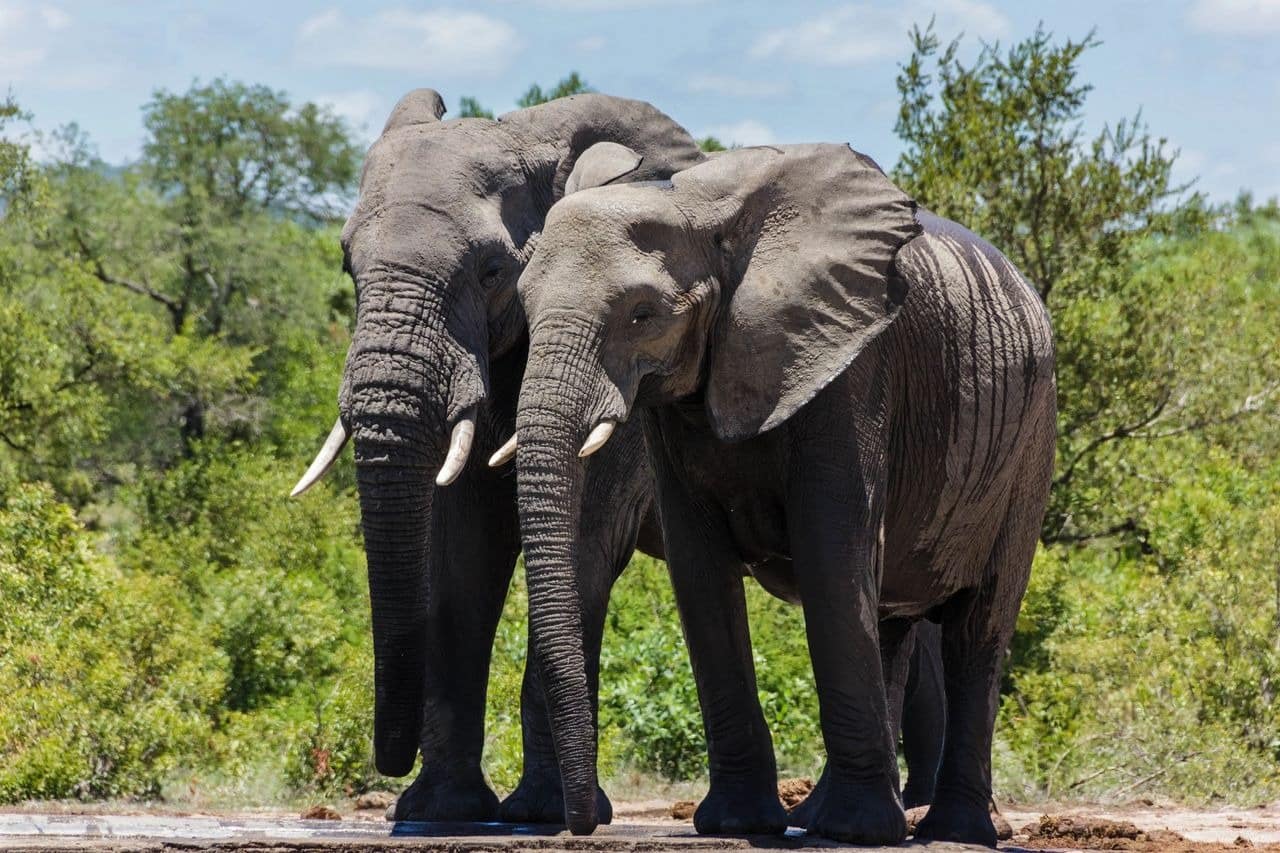
There are only 3 main types of elephants according to most researchers: The African Savanna Elephant, The African Forest Elephant, and the Asian Elephant. All others are subspecies. The largest of the main groups is the African Savanna Elephant, and interestingly, it’s ears are shaped quite a bit lime Africa (you know, the continent). Elephants’ closest genetic relatives are said to be manatees, dugongs, and rock hyraxes. Both manatees and dugongs are sea creatures, while the rock hyrax is a small furry animal that looks like a rodent. Despite this, elephants are the largest non-extinct land animals in the world.
Elephant ladies are called “cows,” and elephant males are called “bulls.” If this seems odd to you, keep in mind that the creatures we refer to as cows and bulls are actually cattle, and belong in the bovine family along with buffalo and several other subspecies. One of these days I might write another entry about bovines because I’ve also researched the hell out of them to write THIS paragraph.
God, I love research.
Back to elephants. Elephants have a large temporal gland (glands on their temple) on each side of their head that are similar to sweat glands. This is unique to elephants. If you see an elephant with what looks like water coming from their head, well, run. On a female, this can be a sign of excitement and on a male, it means he is in must, which is kind of like being in heat and extremely irritable at the same time.
Elephant skin, though thick and tough to the touch, is very sensitive. Since they spend a lot of time in the sun and as their only sweat glands are on their feet, this can be a problem. Add biting flies and mosquitos to the mix and elephants have a real problem here. This is why, after a bath, elephants will cover their bodies with dirt. The dirt becomes mud and dries into a hardened barrier to protect their skin.
If you didn’t already know this, tusks are actually teeth that never stop growing. They elongate and poke through the upper lip. In most animals, these are the canine teeth, but for elephants, they are incisors. They are vital to an elephant’s survival. Of course, they reside next to the trunk, which is pure muscle, strong enough to uproot trees and yet dexterous so that they can pick single leaves or flowers. Elephant trunks are, yes, noses. And their sense of smell is so strong that they put dogs to shame.
Can you imagine a drug-sniffing elephant? I can. And it’s terrifying.
Okay look, I know you came here to read about elephant dick. I’m going to get to it soon, I promise. But there is so much cool stuff about elephants that I want you to calm your body and bear with me. Capiche?
Elephant brains are very large and heavy, unlike another large creature of old, the dinosaur. They have long-term memory and experience emotions that are almost human-like. And they’re very smart. They–
Fine fine, let’s just skip the rest and get into the stuff you came for so you can stop bitching:
Elephant cock.
While there are different elephant species of various sizes, we’re going to work with averages here. Most of what we cover is going to be true of all species anyway.
Because elephant males (obviously) have such big dicks, they sometimes take on mythic elements from people who like to make the biggest claims and present them as fact. I’ve read a lot of the material, from trivia websites to scholarly journals and, having not had a chance to see a pacydermian pecker in action, I feel comfortable reporting that yes, 5 feet is a good average, but it includes more than what you might see when an elephant gets a stiffy.
It is also very much prehensile, which is both creepy and cool. Elephants have the largest weaner-to-body mass ration, meaning not only do they have large ones, but they’re even big by normal measuring standards.
This makes me wonder about whale dicks. I’ll have to do more research on that.
My search history is a sight to be seen!
Now for the big question: can elephants actually use their erections as a 5th leg? Is it truly capable of propping up all 2-6 tons of their body? Here’s where I may disappoint you: I’m calling this one unproven or debatable.
Most of the claims I’ve read site a single article by Ed Young featured in National Geographic that claims he saw it happen. Now, National Geographic is a reliable source and Ed Young is a prolific writer who has won a lot of awards, including a Pulitzer prize for “explanatory journalism,” but the photographic evidence is far from convincing and the fact that the feat doesn’t seem to be supported in any of the scientific journals I read, well, let’s just say I’m not convinced. Check out the article here (be prepared to create a free account for the full article). The photographic evidence that I’ve referred to is also on that page. It is under copyright, so I cannot post it here until you start donating money or buying merch through my website. The good news is, the picture is viewable without a full account.
So there you have it–everything you ever wanted to know about elephant johnsons. Plus, I’ve saved you from discomfort by leaving out information such as the girth of an elephant’s junk (6 inches), how his willie becomes S shaped when fully erect, that the orifice of said peenie is y shaped, that males pick up female’s urine or vaginal secretions to test her readiness for sex, how the head of an elephant’s penis twitches, that sex lasts 45 seconds and involves no hip thrusts, and that elephant sperm travels approx. 6.6 feet to reach the egg (as compared to the 3 inches of human sperm). Now you don’t have to think of any of that!
One More Bit of Frippery:
You know the saying, “The elephant in the room”? Yeah, the one I used in the title of today’s blog. It stems from an old fable, which you can read below. It is very short, but quickly developed into a proverbial idiom that means there is an obvious or important issue that no one is discussing. Here’s the fable:
The Inquisitive Man, by Ivan Krylov (1814)
“Good day, dear friend; where do you come from?”
“From the Museum, where I have spent three hours. I saw everything they have there, and examined it carefully. So much have I seen to astonish me, that, if you will believe me, I am neither strong enough, nor clever enough to give you a full description of it. Upon my word it is a place of wonders. How rich Nature is in invention! What birds and beasts haven’t I seen there! What flies, butterflies, cockroaches, little bits of beetles!–some like emeralds, others like coral. And what tiny cochineal insects! Why, really, some of them are smaller than a pin’s head.”
“But did you see the elephant? What did you think it looked like? I’ll be bound you felt as if you were looking at a mountain.”
“Are you quite sure it’s there?”
“Quite sure.”
“Well, brother, you mustn’t be too hard upon me; but, to tell the truth, I didn’t remark the elephant.”